Introduction
With the advancement of technology in today’s world, businesses need the right technology to make their processes smooth, enhance customer experience and facilitate growth. Software often needs to be installed, maintained and uses expensive infrastructure. That is where SaaS or Software as a Service comes in.
SaaS Applications give users access to software via the internet by not having to install them on individual devices. With CRM, project management, accounting and business automation being some examples, SaaS solutions are an integral part of running a business in the present era.
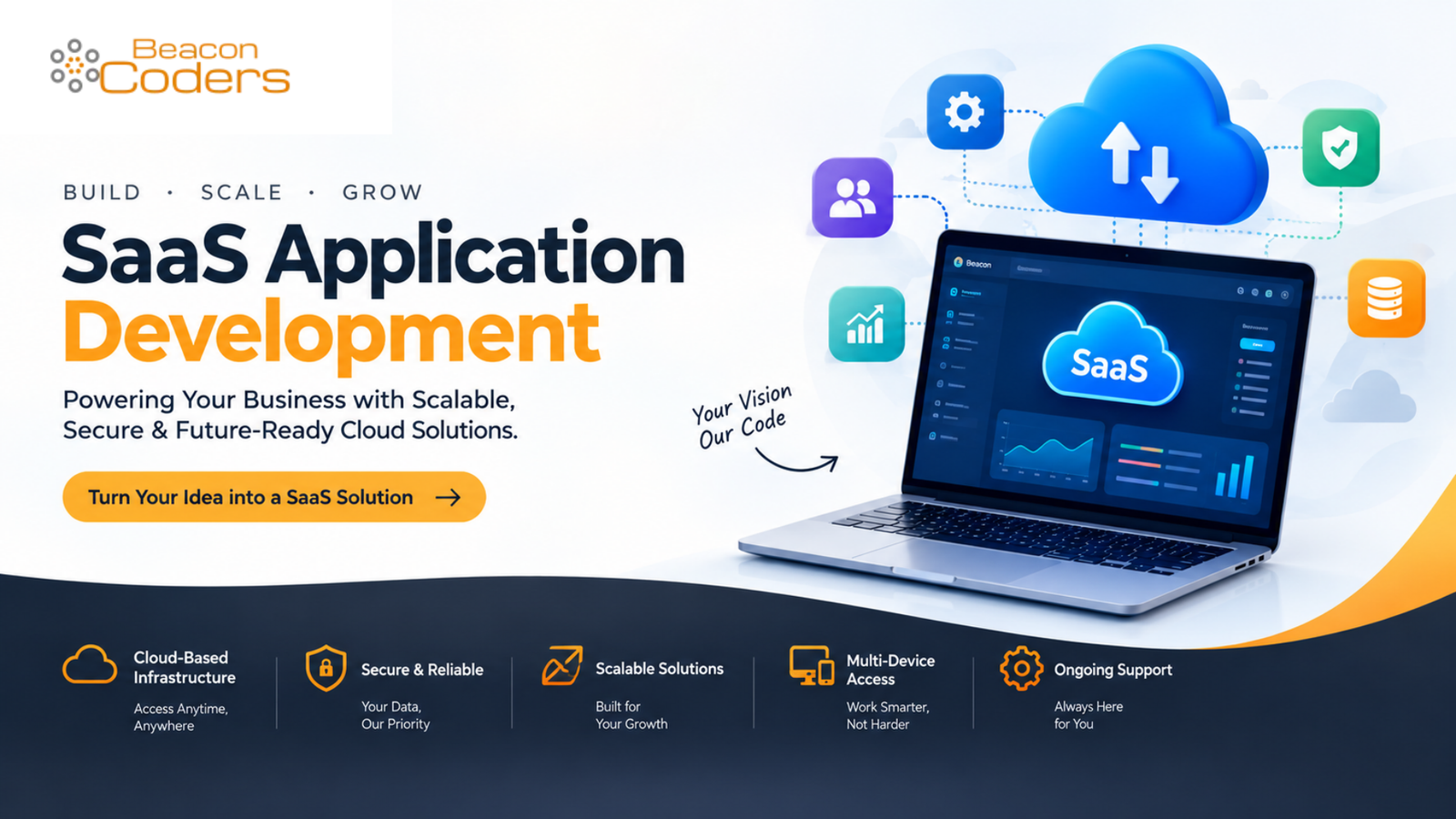
SaaS Application Development is the design, creation, deployment and maintenance of software that uses the cloud and gives users access to the software using a web browser or an application.
Here, in this guide, we look at what SaaS application development is, its benefits, features required, process and why businesses should invest in such software.
What Is SaaS Application Development?
Developing SaaS application is associated with developing an app that will be deployed using cloud technology and distributed to customers via the Internet.
Some of the most common SaaS applications are Google Workspace, Salesforce, Slack, and Microsoft 365.
Unlike traditional apps, SaaS applications are usually priced based on a subscription model. Companies have a choice between monthly or yearly plans and thus can provide their product to a variety of customers.
A successful SaaS application is usually composed of the following components:
- Infrastructure
- Authentication and authorization
- Subscription and billing management
- Data storage and protection
- Upgrades and support
- Integration with third-party apps
- Scalability
This makes SaaS a good solution for startups, small companies, and corporations.
Why Is SaaS Application Development Important for Businesses?
Companies prefer SaaS because it simplifies their operations and brings more flexibilit
The following points explain why it is important to develop SaaS applications:
1. Reduced Costs to Start
Classic software demands high investments into infrastructure, hardware, and installation process. There is a reduction in all these expenses since SaaS applications work on cloud infrastructure.
2. Accessibility
Users can have access to SaaS application from different devices and places, which allows them to work remotely and manage their business.
3. Scalability and Flexibility
With the development of a business, there are changes in the needs for the software as well. Thus, SaaS application can be scaled up by adding users, capabilities, storage space or computational power.
4. Continuous Improvement
SaaS vendors have an ability to update and improve their application regularly. All these updates are available for users automatically.
5. Recurring Revenue Model
There are chances for getting recurring revenue if the company decides to develop a SaaS product.
Key Features of a Successful SaaS Application
An effective SaaS application needs to offer a seamless user experience and satisfy certain business requirements. Among those are the following:
User management – helps the administrator to control the users, roles, and permissions;
Subscriptions management – allows for various subscription and billing models;
Data security – provides for safe storage of sensitive data via encryption, authentication, and secure access;
Cloud-based deployment – ensures that the application can be accessed via the web;
Analytics and reporting – allow the company to track its performance and make better decisions;
Third-party integration – allows the application to integrate with payment processors, CRM platforms, marketing platforms, and others.
The correct set of features will depend on the purposes of your application and your business goals.
SaaS Application Development Process: Step by Step
The creation of a SaaS product requires careful planning, professional approach, and constant improvement. A certain development process will help businesses save money and provide a good product.
Step 1: Define the Business Idea and Requirements
Firstly, you have to define the issue which your application will solve. You need to know what your target audience, competitors, market demand, and necessary functions are.
Step 2: Select a Proper Technology Stack
The technology stack includes programming languages, frameworks, databases, and cloud infrastructure which must be appropriate for performance, security, scalability, and updates.
Step 3: Create an Interface and User Experience
Create an easy-to-use interface for users. Good navigation system, a simple dashboard, and responsive design increase user satisfaction.
Step 4: Develop the Application
In this stage there is frontend development, backend development, database development, API development, and necessary functionality development. Developers create necessary features of the application.
Step 5: Testing and Quality Assurance
Testing and quality assurance must be performed prior to launch for detecting bugs and enhancing reliability.
Step 6: Deployment and Launch
At this point, the application will be launched after being configured for a proper cloud environment. Users will be able to use the software easily.
Step 7: Maintenance and Enhancement
Development is an ongoing process and maintenance and enhancement are needed for maintaining performance of the application.
Choosing the Right SaaS Application Development Platform
Choosing the appropriate SaaS Application Development Platform is a critical decision since the chosen platform will affect the performance, scalability, security, and maintenance of the application.
Companies should base their choice of platform on technical needs, financial considerations, and future growth plans.
Popular cloud platforms include:
Amazon Web Services (AWS): Provides cloud computing, storage, databases, and other infrastructure services.
Microsoft Azure: Provides cloud hosting, application development, and enterprise solutions.
Google Cloud Platform (GCP): Provides application hosting, data analysis, and cloud infrastructure solutions.
The correct platform must provide high-performance capabilities, security, flexible infrastructure, and integrations.
Essential SaaS Application Development Tools
Selecting the right SaaS Application Development Tools enables developers to develop, test, deploy and maintain their application in an efficient manner.
The following are some examples of tools and technology that are frequently used:
React.js: For developing user interfaces.
Node.js: For scalable backend development.
Python: For backend development and automation.
Docker: To containerize your application.
GitHub: For version control and collaboration.
PostgreSQL: For database management.
Jenkins: For software development and deployment automation.
The choice of the tool varies based on the nature of the project, and the knowledge of the development team.
Custom SaaS Application Development vs Ready-Made Solutions
Different businesses have different needs and requirements. The ready-to-use SaaS products come with common functionalities, and might not be compatible with some specific workflows.
This is where Custom SaaS Application Development comes into play.
The custom development process refers to the development of an application based on the specific requirements and purposes of a particular business.
For instance, a real estate company might need SaaS software that provides lead management, property listings, payments tracking, communications, and other functionalities. However, this kind of application is not available as a ready solution.
The advantages of custom SaaS application development are as follows:
- Tailored functionality
- Control over application functionality
- Flexibility in integration
- Possibility to use the application with unique workflows
- Scalability in accordance with the business growth
- Unique market product creation possibility
Despite the fact that custom development might cost more initially, it brings more flexibility in the future.
Cloud Application Development and Low-Code Solutions
Software development is also undergoing changes in the era of cloud computing and more straightforward development processes.
Cloud Application Development deals with the development of applications that are able to operate within cloud computing systems. This approach makes it possible for organizations to obtain computing power, database, and storage without having to have extensive physical infrastructure.
Applications created with the help of cloud computing technology are able to offer remote access, scalability, and collaboration features.
There is another trend called Low Code Application Development. It uses visual development interface, ready-made elements, and drag-and-drop tools to minimize the need for hand-coding.
Low-code systems might be helpful in developing internal applications of businesses, prototypes, and workflows.
However, sophisticated SaaS solutions might still demand custom programming.
How to Choose the Right SaaS Application Development Company?
The selection of a professional SaaS Application Development Company may greatly influence the outcome of your project. A professional development company knows your business goals and turns them into high-quality software.
When choosing such a company, take into account the following aspects:
Technical Expertise: Make sure that developers have experience in frontend, backend, database and cloud technologies.
Experience and Portfolio: Learn about the previous work to know the development abilities of the company.
Security Practices: Find out whether the team observes certain security policies and data protection measures.
Scalability: Verify if the offered architecture will be able to cope with further business growth.
Communications: Pick a team that is ready to share updates and communicate openly.
Post-Launch Support: Determine if the company offers maintenance and monitoring services for your application.
It is very important to choose a development partner that not only builds the application, but also cares about its performance and business value.
Why Invest in Professional SaaS Development Services?
Professional SaaS Development Services are used by businesses to transform software ideas into working and market-ready applications.
Such services include:
- Consulting on SaaS products
- UI/UX design
- Frontend and backend development
- Cloud infrastructure configuration
- API and third-party integration
- Security implementation
- Testing and deployment of software
- Maintenance and support services
Having professional developers for SaaS will decrease possible problems from a technical point of view and allow focusing on business activities.
Conclusion
SaaS apps are revolutionizing the way in which companies build, deploy, and use software products. Flexible, scalable, accessible and affordable infrastructures make them appropriate for companies of various industries.
But developing a good SaaS product goes beyond coding. Business needs, technologies to use, user experience design, security, and scalability are among the factors that must be considered in order to develop a great SaaS product.
Whether you are a startup about to launch its first software product or a company wishing to optimize operations, spending on the appropriate SaaS app is worth it.
Looking for a scalable SaaS application for your business?
At Beacon Coders we help businesses realize their ideas in reliable digital solutions with our modern web and software development services, and cloud technologies. Contact us and let’s talk about your business needs.